Recycling and Sustainability for House Removals
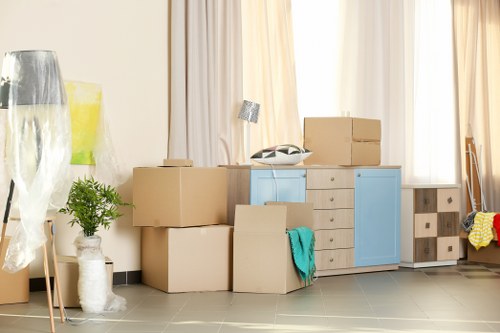 Our house removals approach is built around a simple conviction: moving home should not mean throwing things away. We operate a sustainable house removal service that reduces landfill, supports local reuse and keeps carbon emissions low. From the initial packing stage through to drop-off, our teams prioritise reuse, repair and recycling so that every domestic move contributes to a circular economy.
We have a clear target for waste diversion: 90% of all household items we handle will be recycled, repurposed or donated rather than sent to landfill. This recycling percentage target is reviewed annually and supported by detailed tracking, material sorting and partner networks. Our objective is to move beyond collection and into measurable outcomes so that every residential removals job demonstrates tangible sustainability gains.
![Two professional movers dressed in red work uniforms are standing in a bright, empty room with light wooden flooring and white walls. They are carefully carrying a large wooden chest of drawers, which features a smooth finish and multiple drawers with simple handles. The room has a large window with a closed roller blind on the right side and a smaller window on the left, allowing natural light to illuminate the space. Several cardboard boxes are stacked along the back wall, indicating a household relocation in progress. The movers are positioned facing each other, each holding one side of the chest as they prepare to load or unload it. The setting appears to be a private residence, possibly in a residential area such as [TOWN], with the environment organized for a house removal by House Removals, highlighting careful handling and attention to detail during the move. Overall, the scene reflects a professional furniture transfer activity in a clean, uncluttered space, suitable for residents in the postcode area near [POSTCODE].](/pub/_photos/removals/f2003419136.jpg) Many of the boroughs we serve operate a mixed approach to waste separation ??? with separate streams for glass, paper and card, food waste caddies and designated bulky-waste collections. We align our processes to local rules, ensuring that items are sorted to match the boroughs' approach and local civic amenity (CA) site requirements. Typical recycling and reuse activities include:
Many of the boroughs we serve operate a mixed approach to waste separation ??? with separate streams for glass, paper and card, food waste caddies and designated bulky-waste collections. We align our processes to local rules, ensuring that items are sorted to match the boroughs' approach and local civic amenity (CA) site requirements. Typical recycling and reuse activities include:
- Collection and recycling of cardboard, paper and packing materials
- Bulky waste segregation for furniture, mattresses and soft furnishings
- Special handling and authorised disposal for e-waste and white goods
- Donation streams for usable items to charities and community reuse stores
Local Transfer Stations and Responsible Sorting
We coordinate deliveries to authorised local transfer stations and civic amenity sites to keep routes short and processing efficient. Our teams pre-sort at property level to separate recyclable streams and reduce contamination ??? a critical step since many local councils enforce strict separation regimes. By working with transfer stations we shorten the logistics chain, cut mileage and increase the proportion of material that can be recovered.![Inside a residential property, a young woman with blonde hair tied back and wearing a pink shirt is sitting among cardboard moving boxes, holding a smartphone and smiling as she engages in conversation. Opposite her, a young man with blonde hair, dressed in a light green t-shirt, is also smiling and holding a striped ceramic mug, resting his head on his hand. The scene suggests a moment during a house move in a typical UK home, with plain white walls and a stack of flattened boxes visible around them. The environment is well-lit, likely by natural light. The various cardboard boxes, some partially visible in the background and foreground, indicate packing activity typical of local removals or house relocation services. The image captures a relaxed, positive atmosphere, emphasizing an organised and prepared moving process, which is relevant to the house removals sector in towns such as [TOWN] or the [POSTCODE] area, with an emphasis on customer service and sustainable moving practices promoted by companies like House Removals while preparing for a move or packing-up process.](/pub/_photos/removals/f1229037992.jpg) Partnerships with charities are central to our reuse strategy. We maintain formal arrangements with furniture banks, homelessness support organisations and community reuse centres to ensure good-quality items are diverted where they are needed most. Items that cannot be reused are routed to accredited recycling centres or specialist refurbishers; this includes:
Partnerships with charities are central to our reuse strategy. We maintain formal arrangements with furniture banks, homelessness support organisations and community reuse centres to ensure good-quality items are diverted where they are needed most. Items that cannot be reused are routed to accredited recycling centres or specialist refurbishers; this includes:
- Furniture donation networks for sofas, tables and wardrobes
- Appliance collection channels for working white goods and electronics
- Textile reuse or recycling for bedding and curtains
How we manage materials during a residential removal
Our crew use labelled crates and clear bagging systems to separate materials at source. Before loading, items are assessed for reuse potential and categorised so that transfer stations and charity partners receive sorted consignments. We document each load and provide internal reporting on diversion rates to ensure our recycling percentage target remains transparent and auditable.Fleet choice plays a big role in lowering the carbon footprint of a domestic move. We operate a mix of low-emission vans and electric vehicles for shorter urban legs, and run optimised route planning to reduce mileage on every job. Driver training emphasises eco-driving techniques and careful load planning so fewer journeys are needed. For longer moves we select the most efficient vehicles available and combine loads where possible to minimise empty running.
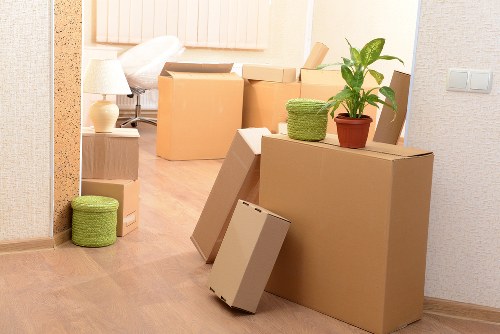 Beyond vehicle emissions we invest in preventive measures that reduce waste generation in the first place. Our teams offer packing solutions using reusable crates and hire blankets instead of single-use materials. We also collaborate with local repair caf??s and community workshops that can restore furniture and appliances, extending the life of household items and supporting the local circular economy.
![A young couple, a woman with long dark hair and a man with short dark hair, sit on a wooden floor surrounded by a large number of cardboard moving boxes in a bright, clean interior space. The woman is wearing a light blue long-sleeve top and jeans, while the man is dressed in a pale blue shirt and dark jeans. They are smiling at the camera, appearing relaxed and happy during a house move. Behind them, the stacked boxes fill the background, some larger and others smaller, all sealed with packing tape. The setting suggests a residential environment, possibly a living room or hallway, with soft, natural lighting illuminating the scene. The scene subtly indicates a domestic move, with the presence of packed boxes and the casual positioning of the couple, emphasizing the themes of house removals and relocation services near [POSTCODE] in [TOWN], as handled by House Removals, with a focus on sustainable practices related to recycling and waste reduction during moving processes.](/pub/_photos/removals/f1262993408.jpg) In practical terms, what you can expect from our residential removals and home removals service is a clear, traceable chain from property to final destination. We maintain records of items diverted to charities, tonnes delivered to transfer stations and the overall recycling rate per job. Transparency matters: it allows both customers and partners to see the environmental impact of each move.
In practical terms, what you can expect from our residential removals and home removals service is a clear, traceable chain from property to final destination. We maintain records of items diverted to charities, tonnes delivered to transfer stations and the overall recycling rate per job. Transparency matters: it allows both customers and partners to see the environmental impact of each move.
Choosing a sustainable house removal company means choosing partners that prioritise reuse, work within borough recycling rules and operate low-carbon logistics. Our commitment is not only to remove possessions safely, but to make every move an opportunity for reuse and recovery. By focusing on donation partnerships, authorised transfer station routing and a low-emission fleet, our domestic removals and residential moving services aim to set a higher standard for sustainability in the sector.
We continually refine our processes ??? increasing the proportion of items that are repaired or reused, improving sorting accuracy to meet local waste separation standards, and investing in cleaner transport ??? all to ensure your move has a positive environmental outcome.
Make your next move greener by asking about our recycling targets and how we partner with local charities and transfer stations. With careful planning, the right logistics and strong partnerships, a house move becomes an act of regeneration rather than disposal.