Health and Safety Policy for House Removals
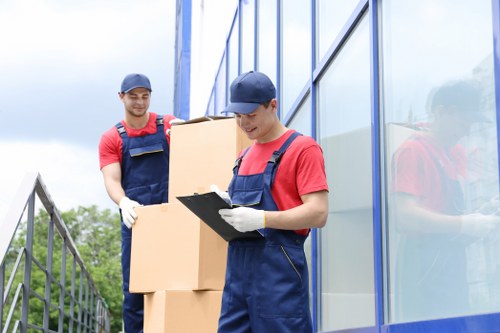 Purpose: This health and safety policy explains how we manage risks associated with house removals and residential moving operations. It sets out responsibilities, safe systems of work and expectations for everyone involved in the process of moving house. The policy covers packing, loading, transportation and unloading of household goods, and emphasises prevention of injury, protection of property and the safe use of equipment during any home removal or house relocation activity.
Scope: This statement applies to all personnel engaged in home moving, including employed staff, contracted removal teams and temporary helpers working on house moving projects. It includes activities at customer premises, in transit and during unloading at destination addresses. The policy also covers the safe management of bulky items, delicate possessions, and any specific hazards encountered during a residential move.
![A group of three young adults with light skin indoors during a house move, surrounded by stacked cardboard moving boxes, some marked with 'Fragile' and secured with packing tape. The woman at the back, with blonde hair and a green top, is smiling and holding a bottle of champagne. In front, a woman with brown hair and a grey shirt is smiling and resting her hand on the shoulder of a man with dark hair, wearing a bright pink polo shirt, who is holding a glass of champagne. They are seated on a beige sofa with a textured fabric, positioned in a residential living room or hallway, with natural light illuminating the scene. The background shows more stacked cardboard boxes, indicating an ongoing move, and the environment suggests a typical UK house setting, possibly in a suburb or town near [TOWN], with the atmosphere cheerful and celebratory during the relocation process. The scene reflects the household context of a professional house removals service, such as House Removals, operating in the UK and supporting local moves within the postcode area.](/pub/_photos/removals/f1253029848.jpg) Policy objectives: To reduce accidents and ill health during a house removal operation by identifying hazards, implementing control measures, providing appropriate training and ensuring suitable equipment is used. The aim is to maintain a consistent approach to safety across every domestic relocation task, ensuring that the risks of manual handling, slips, trips, falls, vehicle incidents and damage to property are minimised.
Policy objectives: To reduce accidents and ill health during a house removal operation by identifying hazards, implementing control measures, providing appropriate training and ensuring suitable equipment is used. The aim is to maintain a consistent approach to safety across every domestic relocation task, ensuring that the risks of manual handling, slips, trips, falls, vehicle incidents and damage to property are minimised.
Responsibilities and Roles
Managers and supervisors must ensure that plans for each residential move include risk assessments, clear task briefings and suitable equipment. They are responsible for allocating competent teams, confirming health and safety arrangements before work starts, and ensuring that protective measures are in place. Staff must follow instructions, report hazards and use the correct tools and personal protective equipment (PPE) for every removal job.
 Staff carrying out a household move should receive training on safe lifting techniques, secure loading, vehicle restraint systems and handling of fragile items. This training helps to prevent musculoskeletal injuries commonly associated with house moving and removal work. Training records will be maintained and updated regularly to reflect changing equipment or methods.
Risk assessments for each home removal should identify hazards such as narrow staircases, uneven surfaces, restricted access, presence of pets or young children, and heavy or awkward loads. Where necessary, alternative methods such as use of lifting equipment, stair climbers or additional personnel will be used to manage these risks effectively during a domestic removal.
Safe Systems and Operational Controls
![The image depicts a family of four in a bright, spacious room filled with packed cardboard moving boxes of various sizes, some stacked against the walls and others placed on the floor. The boxes are plain brown and appear securely sealed, indicating an ongoing house move. A young girl with blonde hair, wearing a beige fuzzy sweater, is holding a small teddy bear and engaged in conversation with a boy who has short dark hair and is wearing a striped shirt, both standing amidst the boxes. In the background, a woman with long blonde hair and a man with dark hair and a smile sit behind the children, observing the scene; they are dressed casually, reflecting a relaxed atmosphere typical during a household relocation. The environment appears to be inside a well-lit room with neutral-colored walls, suggesting a living area or hallway in a residential property. The scene subtly emphasizes the process of packing and moving, as part of a domestic house removals service near the [POSTCODE] or [TOWN] area served by House Removals, demonstrating a family-friendly approach to relocations in the UK.](/pub/_photos/removals/f2012723976.jpg) Manual handling rules must be observed at all times; teams should plan lifts, use two-person methods for bulky items and make use of trolleys, dollies and mechanical aids where possible. Safe loading and vehicle load restraint are essential to prevent shifting loads and ensure safe road travel during house moving or removals transport.
Manual handling rules must be observed at all times; teams should plan lifts, use two-person methods for bulky items and make use of trolleys, dollies and mechanical aids where possible. Safe loading and vehicle load restraint are essential to prevent shifting loads and ensure safe road travel during house moving or removals transport.
Before starting a house removal job, personnel should carry out a site check for trip hazards, loose floor coverings or wet surfaces and take immediate steps to mitigate them. Where households present specific risks (e.g., fragile antiques, medical equipment or hazardous materials), these should be declared and handled according to the agreed safe procedure for that residential move.
 Emergency procedures must be in place for incidents such as injuries, vehicle breakdowns or accidental damage. Staff should know how to summon assistance, preserve the scene, complete incident reports and follow-up with remedial actions. An effective incident reporting system supports continuous improvement across the removal service.
Equipment, Maintenance and PPE
All tools and removal equipment used in home relocation must be maintained in a safe condition. Regular inspections of lifting gear, vehicle restraints and moving aids are compulsory. Any defective equipment will be taken out of service until repaired or replaced to prevent accidents during a house moving job.
Personal protective equipment, including gloves, high-visibility clothing and appropriate footwear, should be provided and worn where required. Teams should also use protective coverings for floors and doors to reduce the risk of damage during a removal and to protect householders' property while work is underway.
For certain removal tasks, additional controls such as corner protectors, furniture blankets and secure strapping must be used. Proper packing and labelling of boxes, together with a clear inventory, reduces handling time and exposure to risk during domestic removals.
Monitoring, Review and Continuous Improvement
Performance in safety for house removals will be monitored through regular inspections, incident analysis and feedback from staff about operational risks. Near-miss reporting encourages proactive management of hazards, and trends will be identified to target improvements in training or equipment for future residential moves.
Periodic review of this policy ensures it remains relevant to evolving removal practices and technologies. Lessons learnt from incidents and audits will inform updates to procedures and reinforce a culture of safety in all house moving activities.
Key commitments:
- Provide competent personnel and suitable equipment for every home removal task.
- Carry out and record risk assessments for each residential moving job.
- Maintain equipment and ensure appropriate PPE is available and used.
- Report and investigate incidents and near-misses to prevent recurrence.
- Review and update the policy as removal practices change.
By following these principles, removal teams and clients can work together to ensure that the moving process is conducted safely, efficiently and with respect for both people and property during every house relocation.